This spring I had the opportunity to go to NTU Singapore for exchange studies during my MSc in Complex Adaptive Systems. NTU is one of the highest ranked universities both in general, engineering and AI-technology. It was an amazing experience, with a lot of both cultural and academic learnings, travel to nearby countries and amazing food. My goal here is to share a bit about the most noteworthy learnings.
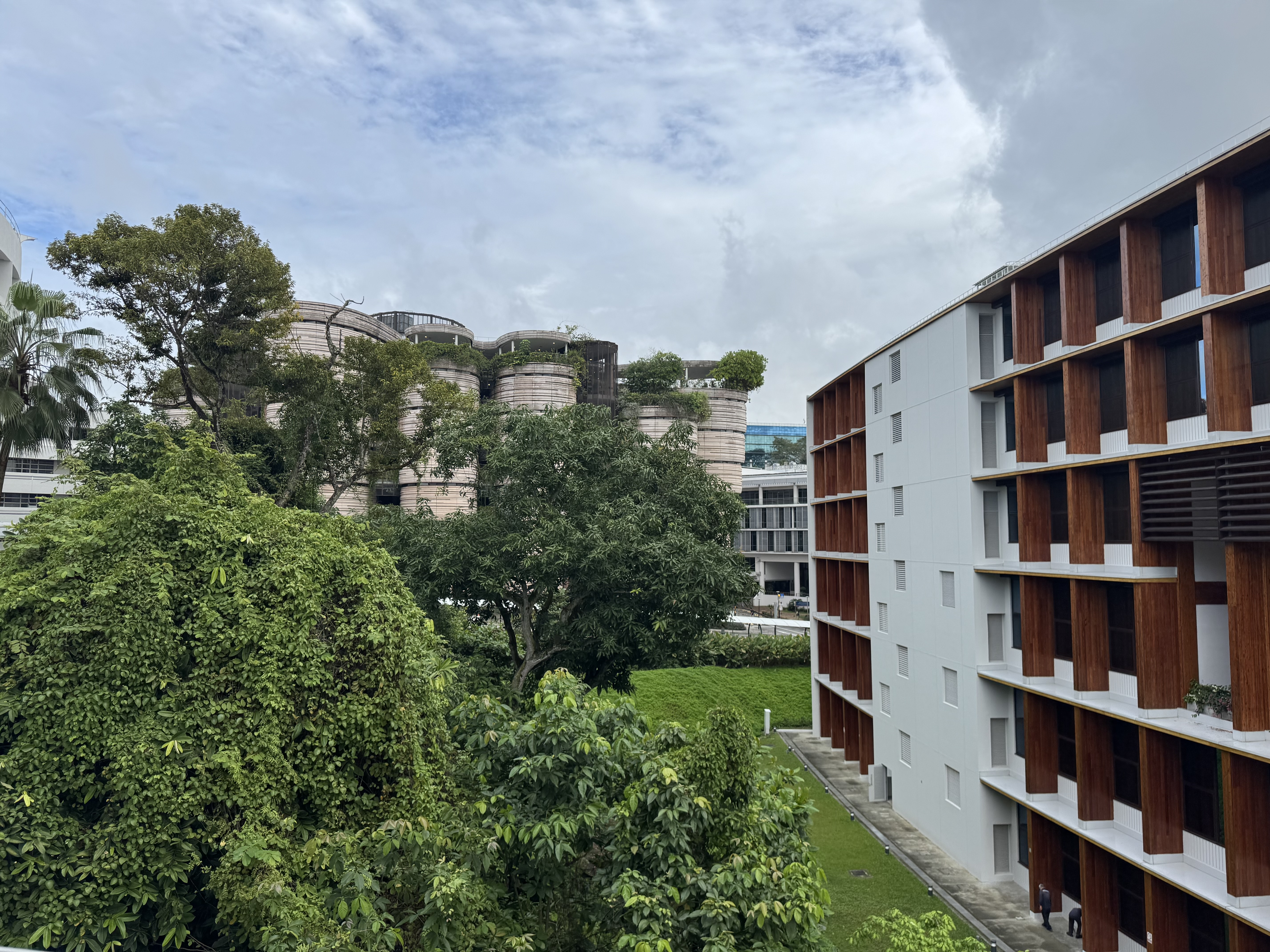
Let's start with the courses. I had the opportunity to choose a lot of elective courses, but really wanted to take advantage of the top knowledge NTU offers in Technology. My favorite course was one called Physics in the Industry. We were a small class and it was split up into four different sections, talking about Chip Manufacturing, Audio, Technology in Food and Biomedical Industry. It was a great introduction to many fields and the knowledge from the Semiconductor Industry really interested me. Furthermore I took part in a Neural Networks & Deep Learning course, which was amazing for deepening my understanding for applying Neural Networks into real systems.
As noted, I also tried to select some other courses I would not have taken in Sweden, like a course in Business Operations and Processes, and Leadership in the 21st Century. The business course was a bit outside my comfort zone, but I must especially highlight Leadership in the 21st Century. We looked at the most recent research in what makes a good leader, how to adapt to people you are leading, and also got time to analyze ourselves to understand how we can become better leaders. There were some techniques that were very thought out and seemed good, and some that felt like master suppression techniques that I rather want to stay away from. At least seeing them pull up stereotypes and telling us to use them made me understand how large cultural differences can be.
Singapore is a place with amazing blended Chinese, Malay, Indian and other international cultures everywhere. This was especially visible in terms of food where there was everything from Korean bibimbap, Indian food, chicken and rice, and the amazing breakfast kaya butter toast. Even though there were so many options, I must say that the vegetarian options were way worse compared to other countries around I travelled to like Thailand, Vietnam and Malaysia. I tried my best though to explore the options around the school and city to find nice meals, and accidentally sometimes took something that seemed very interesting but happened to not be vegetarian. I will definitely bring the hand-pulled noodles to Sweden and start making them myself!
Housing in Singapore can often be tricky, but the school had this solved for us. I had a dorm room I shared with a nice Swiss guy, close to other friends and training facilities, and the school just a 10 min walk away. Since I love training I tried to fit this in as much as possible, but the constant heat (28–32°C) shaped the daily routines with early morning runs and sessions in the evening. I also had the opportunity to train with the school's triathlon team, becoming really good friends with some of them and always having a training partner.
Singapore's location makes it the perfect gateway to Southeast Asia, and I made sure to take advantage of that. I managed to visit Malaysia, Thailand, Indonesia, Hong Kong, Beijing, Japan and Vietnam during my time there and on the way home, each offering something completely different. Everything from amazing street food stalls in Hanoi to the stunning nature in Malaysia. These trips were some of the highlights of the semester and gave me a much broader perspective on the region.
Something that is not so surprising is that Singapore is very technologically advanced. Everything from entering through the airport to the self-driving MRT system, and the city feels like it is constantly pushing forward. At the same time, some parts feel less developed, like the payment methods at Hawker Centers. Singapore is also surprisingly car-centric for such a small country. There are wide highways and large parking structures, despite the extremely expensive car ownership costs. It is an interesting contrast that says a lot about how urban planning and technology do not always go hand in hand.
Looking back, going on exchange was one of the best decisions I made during my time at Chalmers. Beyond the academics, I came back with a much stronger sense of independence, a deeper cultural awareness, and friendships that span across the world. Studying only in Sweden would never have given me that perspective. If you are considering going on exchange, I cannot recommend it enough. It will challenge you, change you, and give you experiences that no classroom ever could.
Back to all posts